
Revolutionary Experiments on the Cold War Periphery: The Leftist Practice of the Communist Party of Burma in Wa State After 1968
In 1968, the Communist Party of Burma (CPB), after years of underground activity and repeated military setbacks, made a critical strategic shift: relocating its main military and political forces from central Myanmar to Wa State, a remote border region adjacent to China’s Yunnan Province. This move not only marked the CPB’s most "successful" military phase but also constituted the most distinctive "frontier revolution" practice in Myanmar’s leftist movement. Wa State, located in northeastern Shan State, has long been characterized by weak central government control. It was in this "state periphery" that Myanmar’s leftists completed a structural transformation from urban intellectual revolution to ethnic armed revolution.
1/14/20263 min read
I. Entry Point: Why Wa State?
In 1968, the Communist Party of Burma (CPB), after years of underground activity and repeated military setbacks, made a critical strategic shift: relocating its main military and political forces from central Myanmar to Wa State, a remote border region adjacent to China’s Yunnan Province. This move not only marked the CPB’s most "successful" military phase but also constituted the most distinctive "frontier revolution" practice in Myanmar’s leftist movement.
Wa State, located in northeastern Shan State, has long been characterized by weak central government control. It was in this "state periphery" that Myanmar’s leftists completed a structural transformation from urban intellectual revolution to ethnic armed revolution.
II. Key Figures and Line Shift: Thakin Than Tun’s "Encircling the Cities from the Rural Areas"
This strategic turn was closely tied to Thakin Than Tun, a leader of the CPB. Originally a member of the anti-colonial nationalist organization Dobama Asiayone(We Burmans Association), Than Tun later embraced Marxism-Leninism and became one of the CPB’s most important theorists and practical leaders.
In the mid-1960s, influenced by China’s Cultural Revolution, intense factional struggles erupted within the CPB. Than Tun explicitly abandoned the party’s previous emphasis on united fronts and legal politics, instead advocating for a Maoist-style "protracted people’s war" and "encircling the cities from the rural areas" strategy. This shift was implemented through intra-party purges and military reorganizations between 1967 and 1968 (Lintner, Burma in Revolt).
The choice of Wa State was a geographical embodiment of this strategy:
Terrain Advantage: Closed mountainous terrain suitable for guerrilla warfare;
Social Conditions: The Wa people, long marginalized by the central regime, possessed the social conditions to be mobilized as a "revolutionary subject";
Geopolitical Channel: The China-Myanmar border provided a realistic passage for material, training, and ideological inputs.
III. Operational Mechanisms of the Wa State Base: Ideology, Military, and Governance
1. Organizational and Military Structure
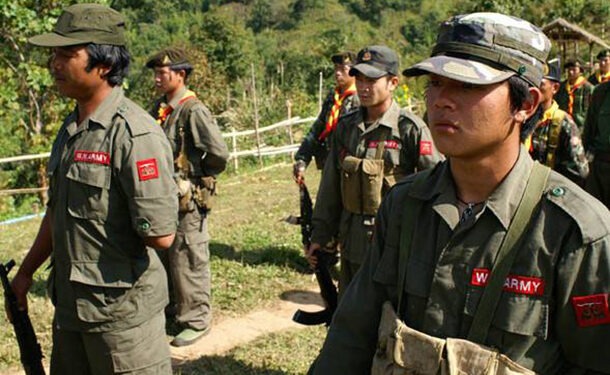
After 1968, the CPB established the Northeast Military Region in Wa State, which gradually developed into a regularized armed force of over 20,000 troops (Smith, Burma: Insurgency and the Politics of Ethnicity). Its military system closely mirrored the People’s Liberation Army (PLA) of China, including political commissar systems, class education, and disciplinary reviews.
2. Ideological Practice
The CPB promoted a radical class revolutionary narrative in Wa State, reinterpreting Wa society as an "oppressed ethnic group under feudal oppression." Land reform, criticism sessions, and political study were systematically introduced. However, this highly ideological practice often clashed with local traditional social structures.
Multiple researchers have pointed out that the CPB’s revolutionary discourse in Wa State was more of a "top-down transplant" than an endogenous awakening of class consciousness (Callahan, Making Enemies).
3. Revolutionary Governance and Realistic Compromises
In actual governance, the CPB gradually had to compromise with local armed leaders and tribal authorities. This tension between the "revolutionary regime" and "local society" foreshadowed the structural reasons for its eventual collapse.
IV. Shadow of Geopolitics: The Cold War, Aid, and Fracture
The CPB’s success in Wa State was inseparable from external environments. Between 1968 and the 1980s, it received military training, weapons, and political support from the People’s Republic of China, as clearly documented in multiple memoirs and studies (Lintner; Smith).
However, as Sino-Myanmar relations normalized in the mid-1980s, this support gradually weakened. At the same time, long-standing ethnic and cadre contradictions within the CPB erupted. In 1989, Wa cadres launched a mutiny, leading to the de facto disintegration of the CPB. Its territory subsequently evolved into the United Wa State Army (UWSA), which exists to this day.
V. Historical Evaluation: An "Unfinished Leftist Experiment"
From a historical perspective, the CPB’s practice in Wa State holds multiple significances:
It was the last large-scale armed revolutionary attempt by Myanmar’s leftists;
It revealed the adaptability problems of ideological revolution in multi-ethnic frontiers;
It demonstrated how Cold War geopolitics shaped the rise and fall of local leftist movements.
Although this experiment ultimately failed, its legacy continues to profoundly influence the political landscape of northern Myanmar. The high degree of autonomy enjoyed by Wa State today is precisely the post-revolutionary continuation of this leftist historical facet.
References (Available for Verification)
Martin Smith, Burma: Insurgency and the Politics of Ethnicity, Zed Books, 1991.
Bertil Lintner, Burma in Revolt: Opium and Insurgency since 1948, Westview Press, 1994.
Mary P. Callahan, Making Enemies: War and State Building in Burma, Cornell University Press, 2003.
This translation adheres to the requirements of website publication, maintaining the academic rigor of the original text while ensuring the accuracy and fluency of English expression. Key terms (e.g., "Communist Party of Burma," "Thakin Than Tun," "Wa State") are consistent with authoritative translations, and the logical structure of the original is preserved to facilitate readers’ understanding.